
Why The Agentic CMO has a second edition already
And why it is now interactive with 27 prompts to bring the frameworks to life

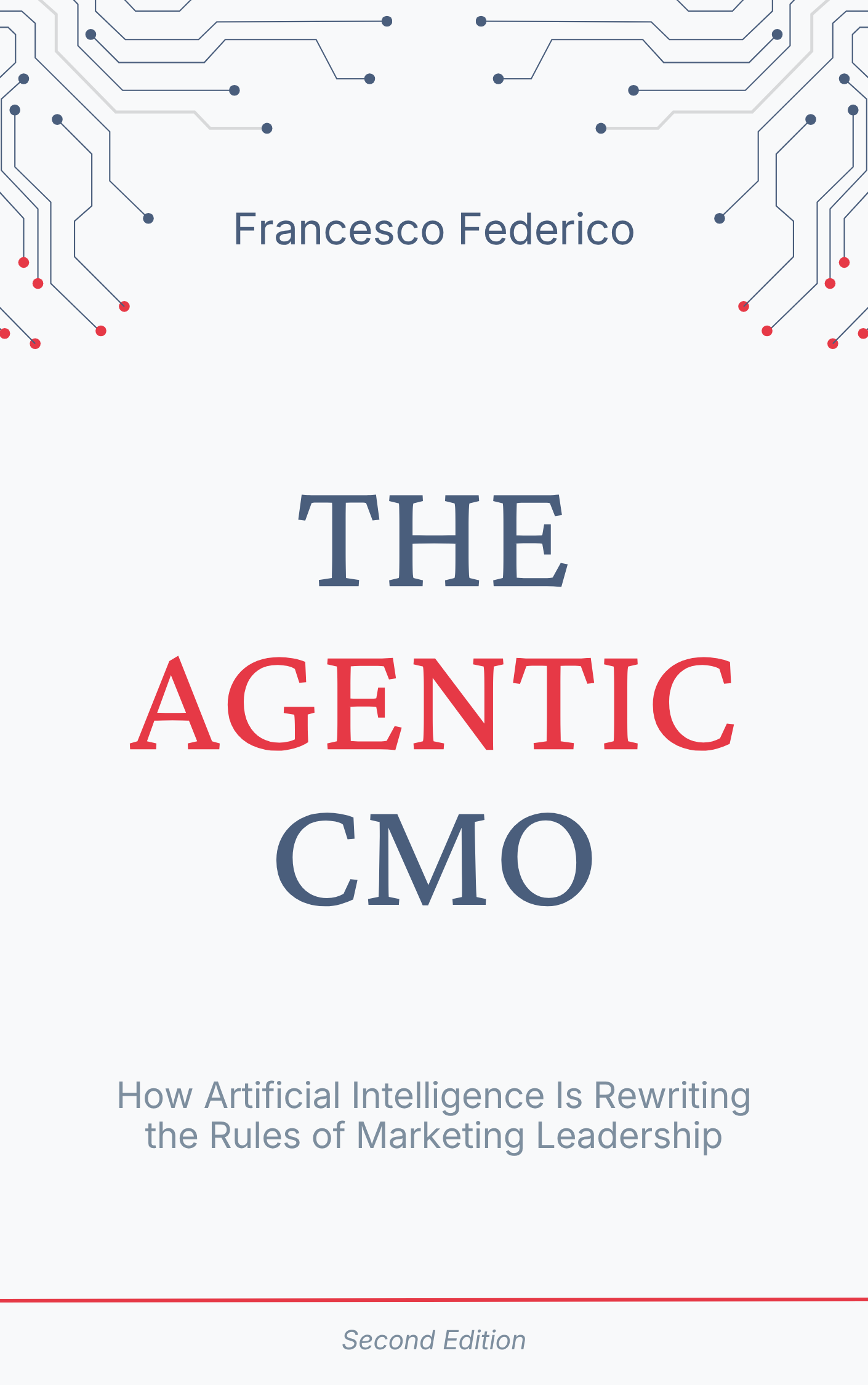
Eleven months ago, the first edition of The Agentic CMO shipped into a field that didn’t yet have a settled name. Agentic systems were experimental. The EU AI Act was a draft. The talent implications were speculative. Sector-specific playbooks felt premature. That changed faster than I expected — and the second edition is the consequence.
What eleven months taught us
The first edition diagnosed the gap between AI ambition and operational reality. It named the failure mode — pilots that performed in isolation and collapsed at scale — and proposed frameworks for closing the gap: Crawl-Walk-Run, the Four Pillars, bounded autonomy, the GUARD Protocol for governance. Those frameworks held. They are unchanged in the second edition.
What didn’t hold was the boundary of the conversation.
By the autumn of 2025, three shifts had become impossible to ignore. The EU AI Act stopped being theoretical the moment compliance teams started writing playbooks against it — and the playbooks bore little resemblance to what the vendors had promised. Then the machine-to-machine economy arrived ahead of schedule: agents transacting with agents, no human in the loop, moving from research paper to revenue line item faster than even the optimists had forecast. The talent question detonated last and hit hardest. Which roles compress, which expand, which disappear, which emerge — and the honest answer is that no one running a marketing function at enterprise scale had a clean view of it. None of these had a dedicated chapter in the first edition. Each earned one in the second.
The fourth addition is the sector-specific playbook. The first edition argued the general case. The second edition admits what every practitioner already knows — that financial services, healthcare, regulated industrials, and consumer goods each face a substantively different version of the same problem, and the operational answers diverge accordingly.
How the book is built
Part I — The Strategic Imperative sets the diagnosis. What agentic AI actually is, where it diverges from the generative-AI conversation the boardroom has already had, and why “we tried ChatGPT” is not the same as “we understand the technology.”
Part II — Designing the Hybrid Organisation. The operating-model section. It tracks the CMO role’s evolution from brand guardian to intelligence orchestrator, makes the capital case for the transition, redesigns the operating model that follows, and lays out the capability and talent architecture required to make any of it work.
The governance and execution core sits in Part III — Implementation Excellence. The GUARD Protocol is here. So is the deployer-side liability treatment under the EU AI Act, the martech-consolidation argument, and the failure modes that reliably destroy value at the pilot-to-scale boundary.
Part IV — Leading the Future turns to measurement, decision-making under uncertainty, and executive alignment — the parts of the job a CMO cannot delegate to a function head, however senior.
Part V — The Playbook is where the practitioner reader will spend most of their time. The machine-to-machine economy chapter (”When Your Customer Is an Algorithm”). The sector-specific operating models. The 90-day transformation plan that closes the book. Each chapter ends with a QR code that activates a prompt or framework you can run against your own organisation.
The deeper claim — that the future of marketing leadership belongs to those who orchestrate human and artificial intelligence as a unified force — was never a forecast. It was a description of what was already happening at the leading edge. The second edition makes the orchestration map more honest about the terrain.
A word on how this edition was produced. It was written using the same agentic methods it documents. The 27 prompts ensure the book not only has longevity, but more importantly, that you can bring the frameworks right into your world and your challenges.
If you read the first edition, the second is structured to reward you: the four new chapters are net additions, the existing chapters are tightened where the field has moved, and the cross-references make it easy to read selectively. If the first edition is new to you, start here. The second edition is the field’s current state of practice in one place.
The hardcover is available TODAY. Paperback and ebook on 1 June 2026. Details and ordering at the-agentic-cmo.com.
Follow me
That’s all for this week. To keep up with the latest in generative AI and its relevance to your digital transformation programs, follow me on LinkedIn or subscribe to this newsletter.
Disclaimer: The views and opinions expressed in Chronicles of Change and on my social media accounts are my own and do not necessarily reflect the official policy or position of S&P Global.